
University of Halabja: Publication of a Research Paper in an International Q1 Journal
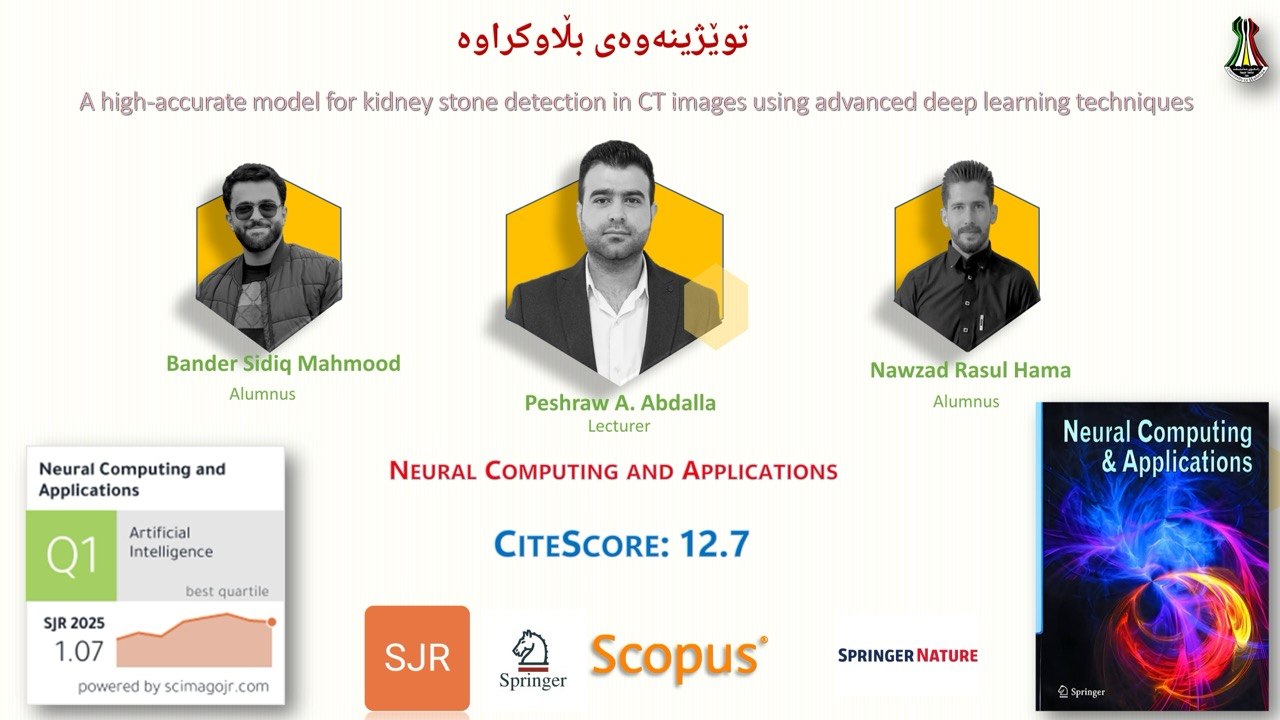
Mr. Peshraw Ahmed Abdullah, a lecturer at the College of Science and the Director of the Quality Assurance and Curriculum Development Directorate, has published a joint scientific research paper alongside two graduates from the Department of Computer Science at the University of Halabja: Mr. Bandir Sidiq Mahmoud and Mr. Nawzad Rasul Hama.
The research, titled "A high-accurate model for kidney stone detection in CT images using advanced deep learning techniques", has been published in the journal Neural Computing and Applications. The journal is published by Springer, holds a CiteScore of 12.7, and is ranked in the first quartile (Q1) of SJR.
- To view the research paper, click the following link: https://link.springer.com/article/10.1007/s00521-026-12256-z
- To read the full research paper online, click the following link: https://link.springer.com/epdf/10.1007/s00521-026-12256-z?sharing_token=oYUxG5BS5HoF0gnqnXoZPPe4RwlQNchNByi7wbcMAY44Ni6JaHUW2wpCLm8Sf7g--xSrMJ4r9_OjATkH94dGLoWtebMGW7L4O-lbo1uHe7uk-TEjxN0eYPT58tQBZoSLmAIIztiGENCzC0vjL_cdNIQeB3JrQrbuSQqemF-eyhY%3D
💡 What is the significance of the research and how does it work?
By utilizing advanced Deep Learning techniques, specifically Convolutional Neural Networks (CNN), an intelligent model was developed to automatically and with exceptionally high accuracy detect kidney stones within CT scans.
🌟 Key Features of this Scientific Achievement:
- 🎯 Unprecedented Accuracy: The model possesses an exceptionally high success rate in identifying the location, size, and type of the stone.
- ⚡ Time Efficiency: It significantly reduces the time required to analyze images, which aids in faster patient treatment.
- 📉 Error Reduction: It drastically minimizes the likelihood of missing very small or hidden stones.
- 👨⚕️ Support for Clinicians: It assists radiologists in making diagnostic decisions with greater confidence, particularly in high-workload hospitals.
- First Research (Regarding the dataset used): Published in the journal Data in Brief by Elsevier (IF: 1.9, CiteScore: 3.4, SJR Q1). 👉 Read here
- Second Research (Regarding the real-time detection application): Published in the journal Invention Disclosure by Elsevier (CiteScore: 1.2, SJR Q3). 👉 Read here
📌 Summary: This medical breakthrough demonstrates how merging computer science with medicine can make human lives easier and healthier. The development of such intelligent systems will become a core component of hospitals worldwide in the near future.
Previous Foundational Work
It is worth noting that this study is the third research paper in this specific field. The researchers previously completed two other studies that served as the foundation for this current work: