
Publication of a New Scientific Research Paper in a High-Impact International Journal
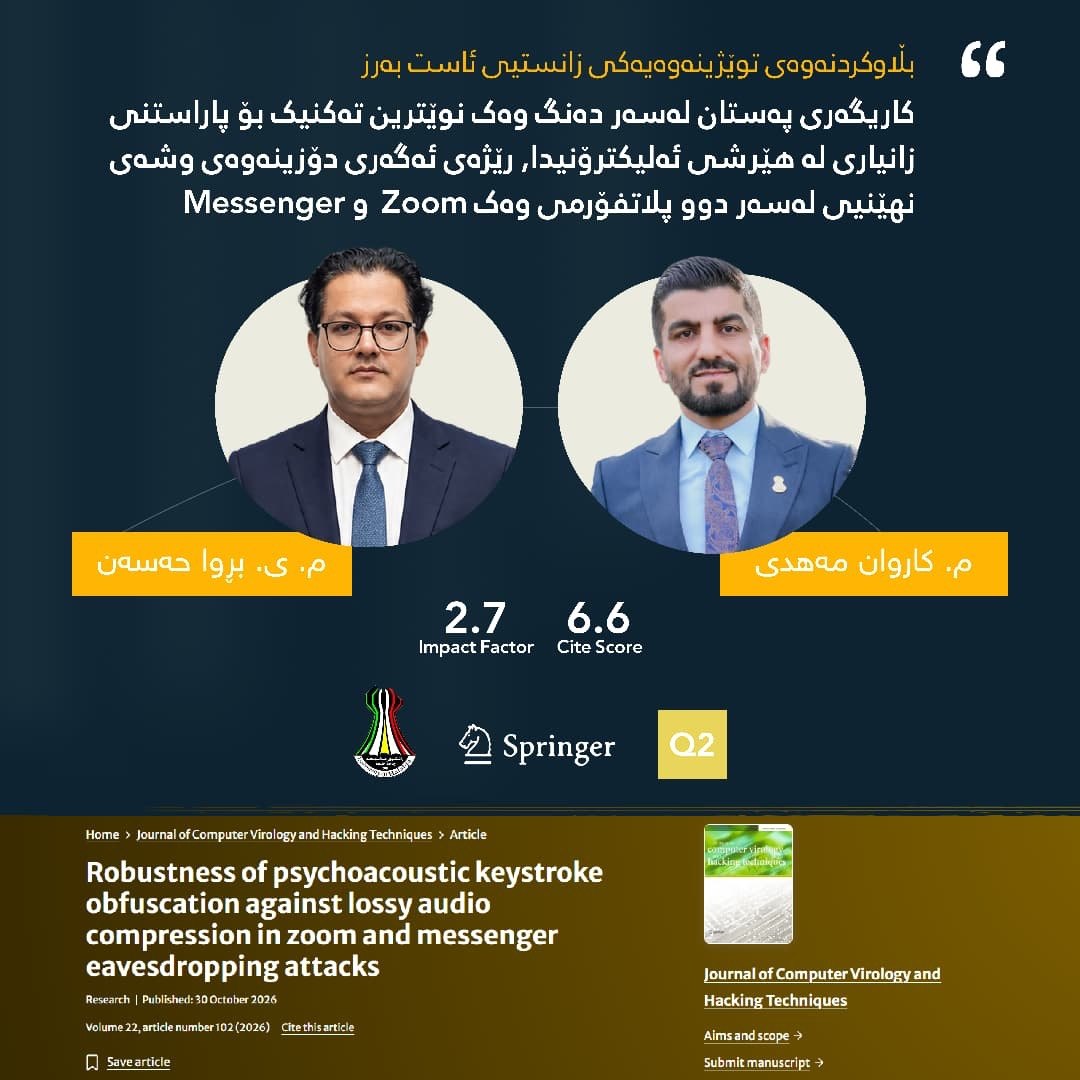
Mr. Karwan Mahdi Hama Raouf and Mr. Brwa Raheem, lecturers at the Computer Science Department, College of Science, have published a high-level scientific research paper in the fields of cybersecurity and artificial intelligence titled:
(Robustness of Psychoacoustic Keystroke Obfuscation Against Lossy Audio Compression in Zoom and Messenger Eavesdropping Attacks)
The paper was published in the Journal of Computer Virology and Hacking Techniques, a Springer journal with an Impact Factor of 2.7 and a CiteScore of 6.6 (Q2). This marks the fifth publication in a series of studies focused on acoustic keystroke cyberattacks and their mitigation using artificial intelligence.
Research Abstract: In a previous study, we introduced a defense mechanism that adds minor, targeted perturbations (P-PGD) to keystroke sounds, increasing the recognition model's error rate to 92.4% on clean, local recordings. However, real-world attackers rarely obtain clean audio; instead, they capture audio altered by internet compression. Therefore, this study tested the defense mechanism on audio transmitted through Zoom and Messenger.
Key Results:
The success rate of the defense starts at 18% and reaches 34% on Zoom and 46% on Messenger, which is significantly lower than the 92.4% on local audio. This demonstrates that audio compression partially weakens the defense.
Increasing the optimization steps from 150 to 500 yielded no benefit, indicating the limitation stems directly from the transmission channel.
The defense mechanism is less effective on Messenger compared to Zoom.
The probability of successfully cracking an 8-character password is only 4.18% on Zoom and 0.75% on Messenger, though a risk still remains for single keystrokes or short PINs.
With these findings, this becomes the fifth prominent study in this domain by researchers from our university. The academic community can utilize these insights to stay informed about acoustic cyberattacks and better protect sensitive data.
Research Link:
Journal: Journal of Computer Virology and Hacking Techniques