
A Scientific Research Paper Published in a High-Ranked International Journal with an Impact Factor
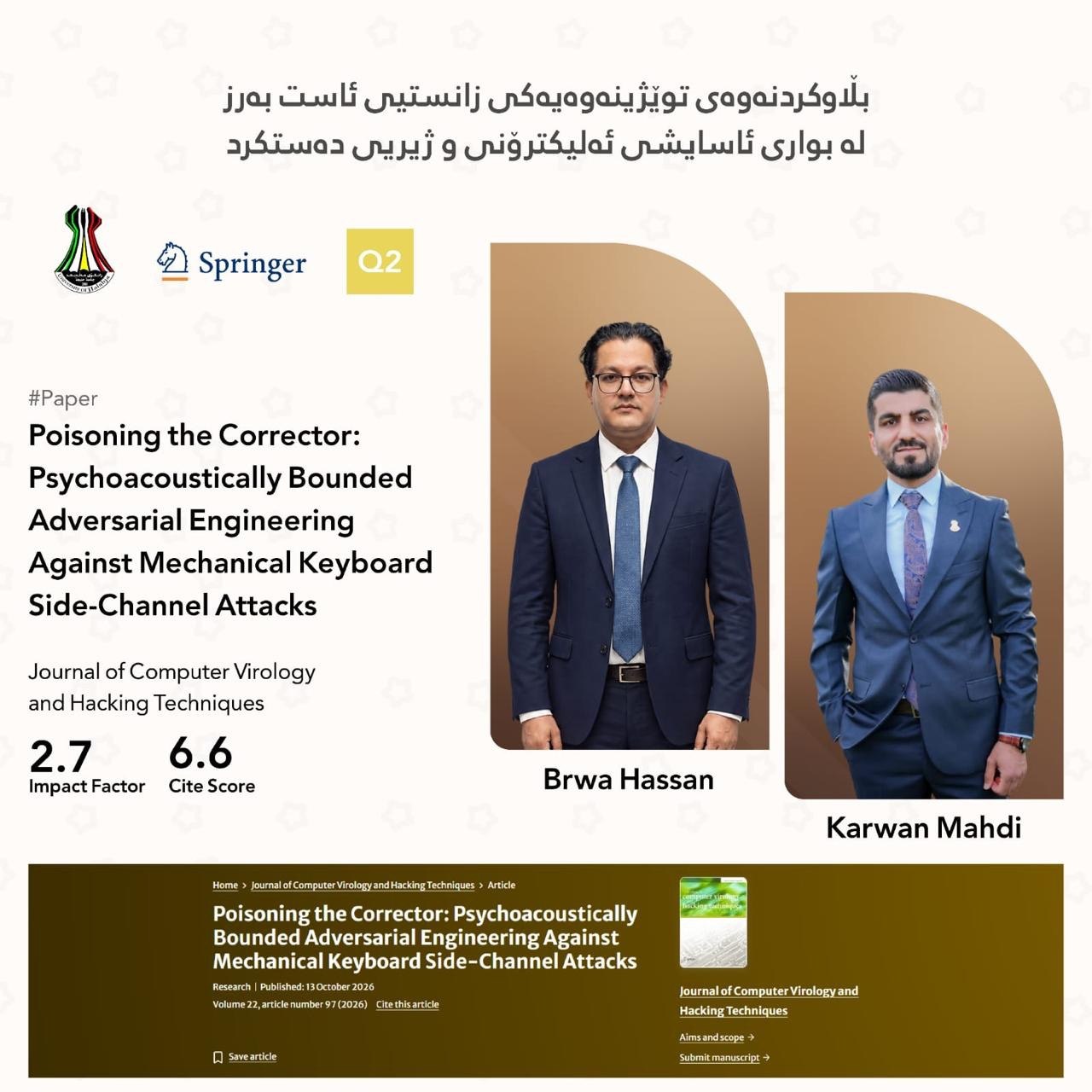
Two lecturers from the Department of Computer Science at the College of Science of our university have published a high-level scientific study in the field of cybersecurity and artificial intelligence in a prominent international journal. Mr. Karwan Mahdi Hamarouf and Mr. Barwa Rahim, lecturers at the Department of Computer Science, College of Science, published a study entitled:
(Poisoning the Corrector: Psychoacoustically Bounded Adversarial Engineering Against Mechanical Keyboard Side-Channel Attacks)
published in the Journal of Computer Virology and Hacking Techniques, which has an impact factor of 2.7, a CiteScore of 6.6 (Q2), and is published by Springer.
Following the publication of three scientific studies in three high-ranked international journals regarding a novel electronic attack technique via keyboard acoustics during typing, this study becomes the fourth to address and mitigate such cyberattacks against technology users using artificial intelligence.
Abstract:
This study addresses a critical security issue: previously, through three studies, we demonstrated a novel technique where keyboard keystroke sounds can be recorded and analyzed using artificial intelligence to reveal typed text, such as passwords. Even if the model makes errors, a language corrector can correct the mistakes and find the correct word. To counter this, the researchers proposed a defense method that adds a small, targeted perturbation using the Projected Gradient Descent (PGD) method to the sound of each keystroke, bounded by the acoustic spectrum of the keystroke itself, targeting both the audio recognition model and the subsequent correction stage for the first time. Results across four keyboards (HP, MSI, MacBook, Lenovo) showed that the model's error rate reached 92.4% across 540 evaluations, while the model erred with high confidence (94.3%), and the dictionary corrector failed to recover the correct word in any of the 40 tests (100%). The study also explicitly demonstrates that the perturbation remains audible, and shows the evaluation of the method on complete correctors belonging to Large Language Models (LLMs) under real-world conditions.
With these findings, this study becomes the fourth in a series published recently in the same field by our university's researchers. Researchers can benefit from it to stay aware of acoustic cyberattacks and protect their data through the development and creation of robust artificial intelligence models.
Link to the Study:
Journal: Journal of Computer Virology and Hacking Techniques
https://link.springer.com/article/10.1007/s11416-026-00677-2