
Physics Faculty Member from University of Halabja Publishes Landmark International Research
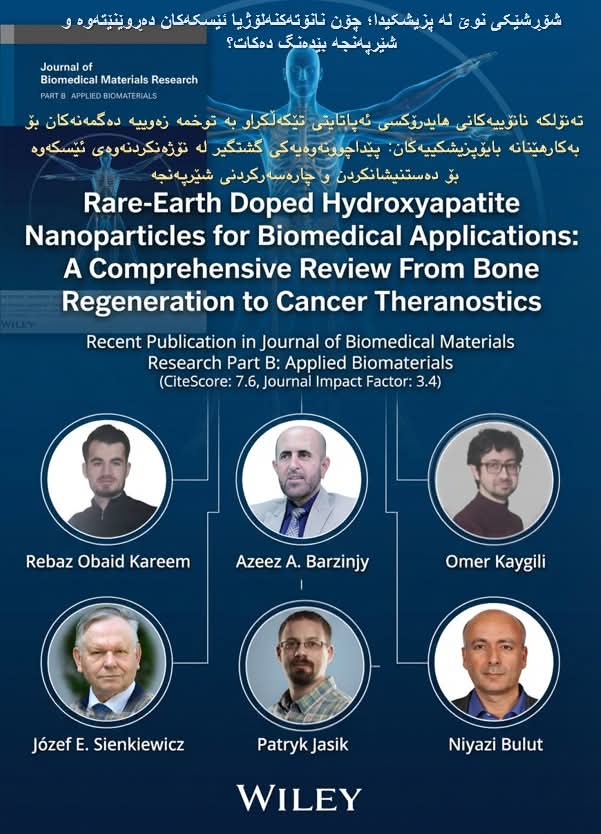
HALABJA — Mr. Rebas Obaid, a faculty member in the Department of Physics at the University of Halabja’s College of Science, has spearheaded a significant international study as the lead researcher. The collaborative project involved a distinguished team of scientists from the Kurdistan Region, Turkey, and Poland.
Overview of the Research
The study, titled as a comprehensive and in-depth review, explores the future of "smart medicine" focusing on Hydroxyapatite (HAp) biomaterials. The paper was published in the prestigious Journal of Biomedical Materials Research Part B: Applied Biomaterials, which boasts a CiteScore of 7.6 and an Impact Factor of 3.4.
The research investigates the advanced applications of Hydroxyapatite—the primary mineral component of human bone and teeth. The study specifically focuses on these materials at the nanoscale, enhanced by the incorporation of 15 Rare Earth Elements (REEs) from the periodic table.
Key Scientific Breakthroughs
This research highlights several transformative advancements in the field of biomedical engineering and nanotechnology:
- Advanced Bone and Dental Regeneration: These nanoparticles function as "smart scaffolds" or fertilizers for the body. They actively stimulate the rapid, high-quality regeneration of fractured bones and damaged dental tissues.
- Superior Antimicrobial Properties: By utilizing specific rare earth elements, the material exhibits potent antibacterial characteristics. This significantly reduces the risk of post-surgical infections, potentially lowering infection rates to near zero.
- The "Theranostic" Leap: Perhaps the most significant breakthrough is the development of a Theranostic system. Acting like a biological "GPS," these materials can simultaneously identify cancerous cells through high-resolution imaging (diagnosis) and deliver targeted drug therapy directly to those cells (treatment) without damaging healthy surrounding tissue.
- Enhanced Medical Imaging: Due to their unique luminescent and radioactive properties, these nanoparticles serve as superior contrast agents. They allow for significantly clearer and more precise X-ray and MRI results, aiding in the early and accurate detection of diseases.
Publication Details
For further technical insights, the full research paper can be accessed via the official Wiley Online Library:
DOI/Link: https://onlinelibrary.wiley.com/doi/10.1002/jbm.b.70063